Plus the capacity nobody else has.
Cogito is Decart's LLM inference API: frontier models at ultra-fast speed, on capacity the GPU crunch can't reach. Built for token-hungry, latency-sensitive agents.
Now serving:
 GPT-OSS
 Kimi K2.6Kimi K2.6: Ultra-fastKimi K2.7 Code
 Qwen
Qwen GLM-5.2
The problem
As you scale agents, two ceilings cap your growth.
Speed limits how much each user is worth. Capacity limits how many you can serve. Cogito fixes both.
Speed decides how much each user is worth.
Agents are token-hungry and multi-step. At typical speeds users watch them type, do less per session, and churn. Faster inference makes every user more valuable.
Capacity decides how many you can serve.
The GPU crunch is real, and there is no new supply of NVIDIA GPUs. So growth gets capped: you waitlist users your competitors also can't serve.
Introducing
The Ultra-fast LLM Inference platform
Same prompt. Same model. Cogito's done first. One agent step (reasoning, a tool call, a summary) streamed at each tier's real throughput. Simulated so the page stays stable.
Typical inference
200 tpselapsed 0.00s
measured 0 tok/s
0tok/s
—TTFT/ms
0.00total/s
Write a Python function `debounce` that delays an async call until it has not been called for `wait` seconds. Include a docstring.
elapsed 0.00s
measured 0 tok/s
0tok/s
—TTFT/ms
0.00total/s
Write a Python function `debounce` that delays an async call until it has not been called for `wait` seconds. Include a docstring.
Compared against a typical fast tier at 200 tps, so about 5x. Real-world throughput varies by model and prompt; see the per-model numbers in the catalog below.
How it works
More chips.
Optimized end to end.
We run across Trainium, TPU, and NVIDIA GPUs, tapping every source of capacity so you're never bottlenecked.
Combined with DOS - our multi-chip optimization stack - this turns out to be fast: over 1,000 tps. DOS runs the same frontier model across every major chip at the lowest latency and highest throughput the hardware allows.
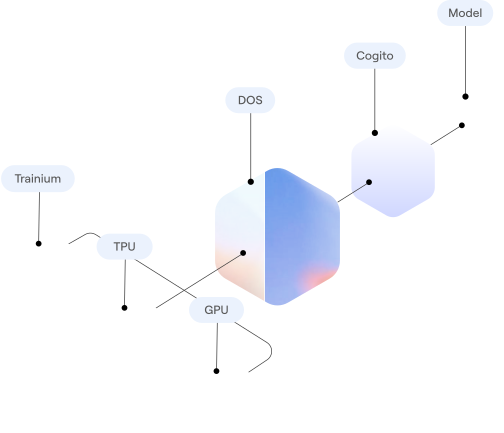
How it works
More chips.
Optimized end to end.
We run across Trainium, TPU, and NVIDIA GPUs, tapping every source of capacity so you're never bottlenecked.
Combined with DOS - our multi-chip optimization stack - this turns out to be fast: over 1,000 tps. DOS runs the same frontier model across every major chip at the lowest latency and highest throughput the hardware allows.
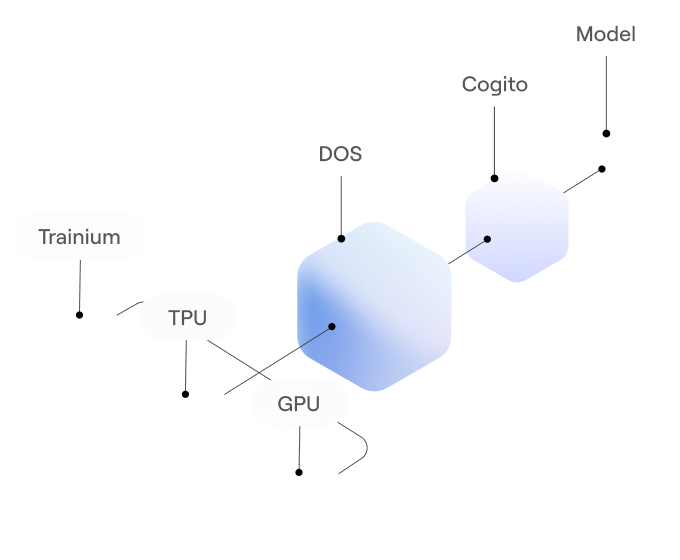
Catalog
Frontier open weights. Curated, day one.
Kimi K2.7 Code · Kimi K2.6 · GLM-5.2 · GPT-OSS · Qwen. Hot the moment they ship. Same per-token price for your fine-tuned variants.
We do real-time inference for a living.
Cogito is Decart's LLM inference layer. We've spent the last two years building DOS — the Decart Optimization Stack — to push real-time AI past what generic infrastructure allows. Lucy 2.0, our diffusion model, generates frames at sub-50ms on AWS Trainium. Cogito is what happens when we point that stack at the open-source LLMs you already use.
The underlying engineering wasn't built for LLMs first — it was built for real-time. That's why the gap between us and a typical inference provider isn't a few percent; it's about 5×.
from openai import OpenAI

client = OpenAI(
    base_url="https://api.cogito.decart.ai/v1",
    api_key=os.environ["COGITO_API_KEY"],
)

stream = client.chat.completions.create(
    model="deepseek-v4-flash",
    messages=[{"role": "user", "content": "Why is the sky blue?"}],
    stream=True,
)

for chunk in stream:
    print(chunk.choices[0].delta.content or "", end="")
Security & trust


- No training on your data
- Zero data retention
- Multi region servers
- Enterprise-grade SLA
Standard endpoints are self-serve, public per-token pricing, no minimums or overage charges. Ultra-fast 1,000+ tps is available through our team.
See pricingGet a key, drop in one URL, and ship today. $5 in free credits, no credit card.